
I've attached a typical result from a face contact test. Theloading face (not shown) is larger in diameter than the die face(shown). Loads are extremely high as is common in this application.I'm having trouble deciding if the high local peaks (400ksi+) oftenfound radomly at vertex nodes can be ignored in favor of theresults shown in the color chart. These appearent singularities area common occurance especially on complex geometry.SolidworksSimulation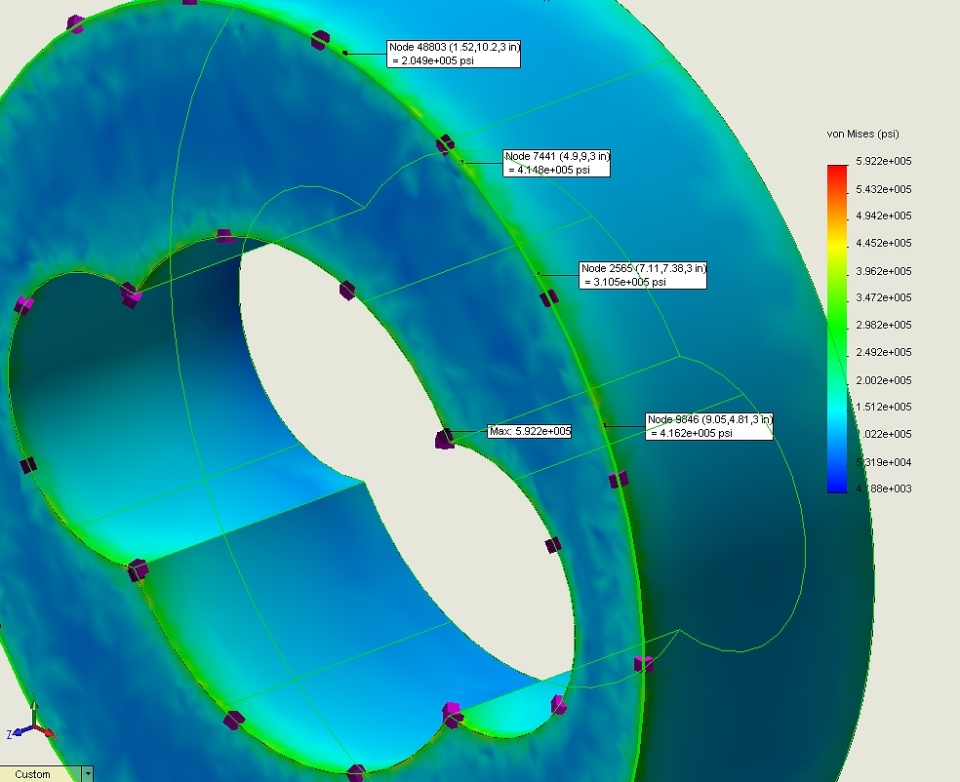


if your objective is to determine the maximum stress, then thedecision to analyze a model with sharp corners is a very seriousmistake. According to the theory of elasticity, stress in the sharpcorners is infinite. The finite element model does not produceinfinite stress results due to discretization errors, and theseerrors mask the modeling error. However in the vicinity of sharpcorners, stress results completely depend on mesh size. Theseresults are totally meaningless at these locations.
If your design intent is to determine the maximum stress you mustinclude a fillet, no matter how small it is.
If you want to check if your FEA model is correct check theconvergence of the displacements results. Usually they convergewhile the stress behave differently.
Hope it is clear and helpfull
We normally dont use model with sharp corners. As Gianlucacommented, we normally use fillets on sharp corners.
I suggest you to probe the stress results on all the nodes [Two tothree layers]close to the high stressed node. If the difference ishuge say above 20% then ignore the high stressed node. If thedifference is less, you should include for failure criteria.
Correct me if i'm wrong.
Regards,
Dave Trent