
Hi I am trying to create a sketch that is basically a sine wave curve along a spline path. I need approx 235 'waves' in the sine. Is there an easy way to create this, as I am also wanting to be able to modify the spline curve, which will then update the sine wave. I created a spline path and then offset a distance and created a series of circles with tangental lines between and cut the lines not required the create the sine wave, but when I modified the spline curve, the tangential relations from the circles fell over, and the sine curve would have to created again along the new spline path.SolidworksSketching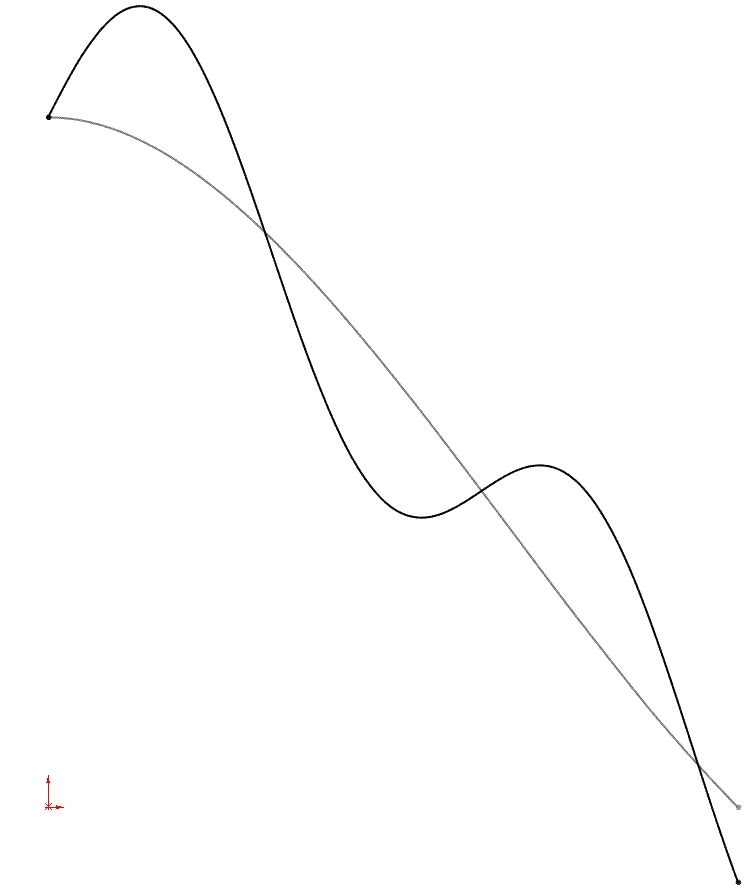


Check out equation driven curve. You will need to figure out an equation for your path. Once you have that add the sine wave to the equation. See attached.
Base: X^3-2*X^2+1
With Sine: X^3-2*X^2+1+sin(10*x)/5
[0-1]
I hope this helps.
Rob Stupplebeen
This is fairly easy once you know the technique!
I have attached an example.
The accuracy of this method is described here (it is accurate enough for typical engineering/manufacturing work, don't worry about it unless you need it for analysis). https://forum.solidworks.com/message/65343#65343
If this is what you are after, you will have to create the 235 arcs manually using the Tangent Arc tool... and the result is a little flakey if you tweak the spline path too much.