
Thanks Ian for drawing our attention to the Dynamic Designerweb site.
I have read the brief explanation in the image below but I haveseen no tutorial examples to elaborate on the explanation. Thesurgical shear could certainly use this function because pullingthe trigger towards you moves the cutter blade away from you, butif this explanation is there, then it must be buried deep in thehyperlinks where I failed to spot it. Perhaps this is why somepeople prefer video training; nothing is buried where it can beoverlooked.
I Googled "action-reaction" and received a zillion explanations ofNewton's third law, but that seems not to relate to objects nottouching or otherwise connected.
In the Cosmos context, it seems to me (coming from the world of PIDand reverse acting transmitters) feasible to explain the"action-reaction force" as a "reverse acting coupler".
Your clarification will be welcome.
SolidworksMotion Studies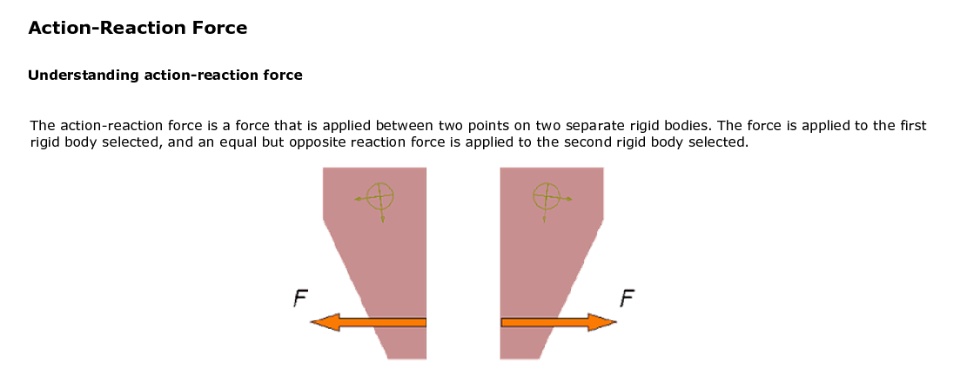
I have read the brief explanation in the image below but I haveseen no tutorial examples to elaborate on the explanation. Thesurgical shear could certainly use this function because pullingthe trigger towards you moves the cutter blade away from you, butif this explanation is there, then it must be buried deep in thehyperlinks where I failed to spot it. Perhaps this is why somepeople prefer video training; nothing is buried where it can beoverlooked.
I Googled "action-reaction" and received a zillion explanations ofNewton's third law, but that seems not to relate to objects nottouching or otherwise connected.
In the Cosmos context, it seems to me (coming from the world of PIDand reverse acting transmitters) feasible to explain the"action-reaction force" as a "reverse acting coupler".
Your clarification will be welcome.
SolidworksMotion Studies

Let me see if any of the following illustrations help out.
If we look at this in the guise of a motor or actuator, there issome means of supplying energy to the system. For a motor we applyan electric current which creates a magnetic field on the rotorwhich is repelled/attracted by the stator magnetic field. So thiefields create a force acting on the rotor and an equal and oppositeforce acting on the stator. Since we do not model the electriccurrent or magnetic fields in motion, we represent this as anaction/reaction moment or as a motor (it all depends on if you aredriving movement or not).
In the case of an air cylinder, we have a chamber with a pressureacting equally in all directions (We add energy by increasing theair pressure). In the radial direction, the forces balance out, sothere is no net force if you were holding the cylinder. But theaxial direction, is the important one. If it were a sealed chamber,the axial forces on the cylinder would also balance out sincenothing is moving. However, because we have a pistion that can moverelative to the cylinder, any pressure is resolved as a force onthe piston in that direction, not to the cylinder. But you stillhave a resultant force acting on the back wall of the cylinderbased on the pressure. We don't model air pressure in motion, so werepresent it as an action reaction force or actuator motion
When you define a motor or actuator in motion, by default it isgoing to be relative to global ground. What this means is that anyreactionary force due to the enforced movement is assumed to bereacted on global ground (as if someone is holding themotor/actuator in place. This can be a problem if you are trying toobtain accurate forces through the structure. In the classic caseof an actuator on a scissors lift, dump truck, excavator etc, theload has to be reacted via the cylinder and what it connects to.That's why you need to specify the reference component where themotor/actuator force is going to be reacted.
In the case of an action only force, we are looking at some form ofenergy that is only applied to one body. An example is a rocket oraerodynamic lift or drag. In the case of a rocket, the thrust forceis reacted on the jettesoned material, which is not modeled, sothat's why it's considered an action only force.
Hopefully you can see that all we are doing is looking at our realworld loading physics and emulating them in the software. Sometimesit's a no brainer how we represent them, but other times it takes alittle more thought.
Let me know if this helps, or if it just makes it more confusing.
Cheers,
Ian
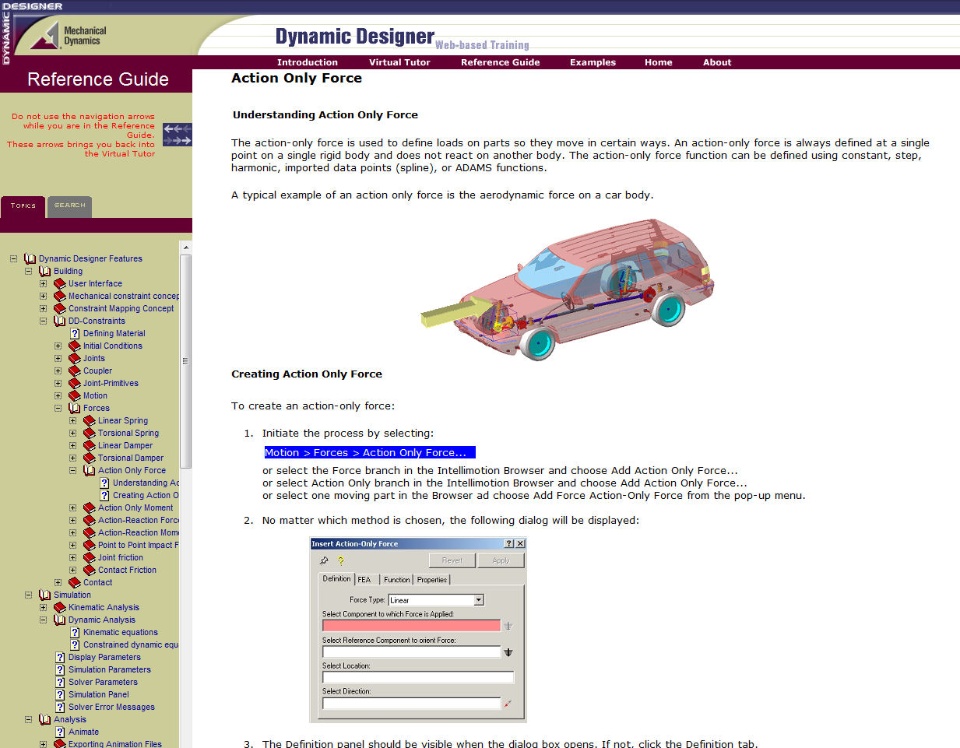
I forgot to mention, on that Dynamic Designer Site, there is acomprehensive reference guide (at least for the version we had backthen).
Select the reference guide and under building you'll seeinformation on the different features along with exercises forpretty much all features.
See image below for an example.
Cheers,
Ian
You also forgot that the image I posted was in your referencemanual. I have turned it into a pdf file and printed it.
Your explanation of Action-Reaction Force is clear, and suggests itmodels a force field. I had not thought of air as being a forcefield but I will deem it to be one. Similarly a rope over a pulleycould be deemed to be a force field.
Many thanks.
Yes, the content of the reference guide was intermingled with thevirtual tutor. It was more a way of giving access to information ina logical feature manner, but there are more exercises intermingledin there than in the tutor.
It's interesting you use the term "force field". Just remember thatthe force direction is along the line of action between the twoattachment points (just like a spring or damper behaves ). So it isapplied as a single point (not truly a field. ADAMS actually has aField force, but it's not in the COSMOSMotion interface). Sincewe're treating with objects as rigid bodies, applyign the force ata single point is not an issue. However when taking the loads intoCOSMOSWorks, you need to ensure it is distributed over theappropriate surfaces.
For the action only force, the force direction is governed by thereference component. Yuu defien the initial direction in theproperty manage/dialog, but if the reference part rotates relativeto the part the force is applied to, the direction will change. Youhave 3 options in essence for this type of force:
Applied with respect to ground (force direction is fixed over time)
Applied with respect to another moving part (direction changesbased on relative rotation)
Applied with respect to the body (force direction relative to thebody stays the same)
Cheers,
Ian