
Hello,
I need to model an ionic liquid in Materials Studio ([BMIM][PF6]). I have drawn it, assigned its charges and the force field. The problem is that I want to have the anion and the cation in a position that has the minimumm energy but with Geometry Optimization tool only the position of the intramolecular bonds are changing and the position of the anion and the cation is the same where I have drawn, it does not ever put the anion at different locations with respect to the cation,at most they get closer. Is there any tool in Materials Studio which can try different conformations of anion and the cation and decide the one with the lowest energy?
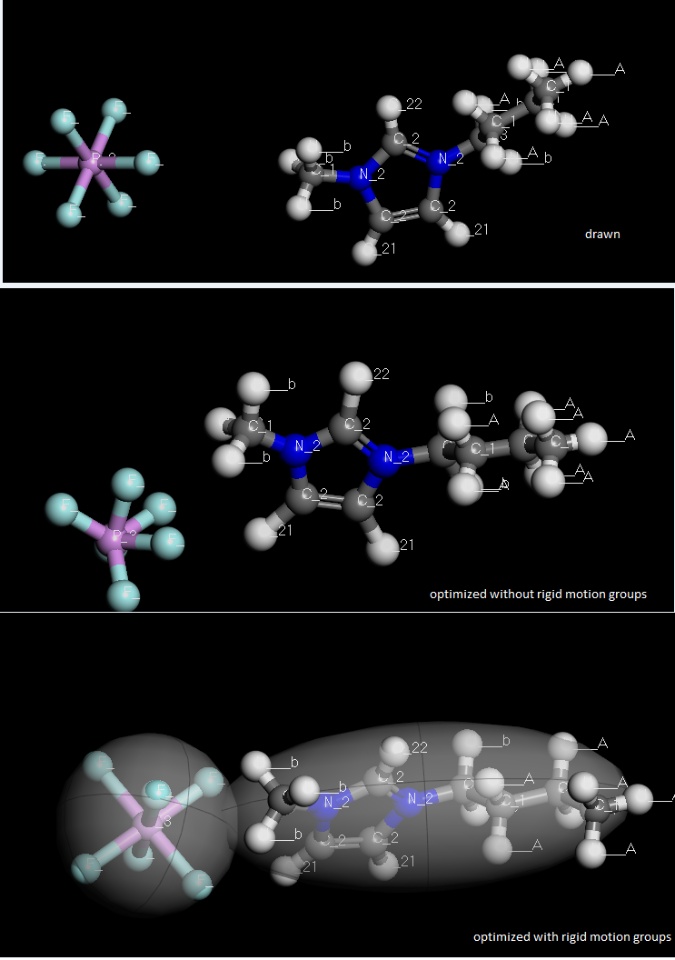
I have one last question also. While doing geometry optimization, if I do not keep the motion groups rigid, the last conformation is not logical. Does anyone have a suggestion about this? I set the quality to ultra fine and I have increased the number of max. iterations to 50000000,but the convergence criteria is not satisfied.
I have attached the pictures of the all the ionic liquids as I draw, geometry optimized with and without rigid motion groups.
Thank you very much,
Çiğdem
I need to model an ionic liquid in Materials Studio ([BMIM][PF6]). I have drawn it, assigned its charges and the force field. The problem is that I want to have the anion and the cation in a position that has the minimumm energy but with Geometry Optimization tool only the position of the intramolecular bonds are changing and the position of the anion and the cation is the same where I have drawn, it does not ever put the anion at different locations with respect to the cation,at most they get closer. Is there any tool in Materials Studio which can try different conformations of anion and the cation and decide the one with the lowest energy?
I have one last question also. While doing geometry optimization, if I do not keep the motion groups rigid, the last conformation is not logical. Does anyone have a suggestion about this? I set the quality to ultra fine and I have increased the number of max. iterations to 50000000,but the convergence criteria is not satisfied.
I have attached the pictures of the all the ionic liquids as I draw, geometry optimized with and without rigid motion groups.
Thank you very much,
Çiğdem

Dreiding does not know about the PF6 anion.
The only force field in Materials Studio which knows about PF6 is COMPASSII (not keeping UFF in mind).
One can use the Conformers module (the CH3 Groups may have to be included but only for a torsion range 0-.120°) to generate a trajectory which can then be used in Blends using the Binding Energy Task to get a trajectory with the lowest energy frames which then can be further optimized or use the Adsorption locator from the beginning
-> There are lots of possibilities.
If just the PF6 anion is treated as motion group/rigid body one can perhaps give Dreiding a try.
Thank you very much for your reply.
I used a forcefield mentioned in a computational work which inserts ionic liquids in a metal organic framework. For the cation they use AMBER forcefield and for the anion they use parameters mentioned in another article. However, to assign these parameters to the ionic liquid in Materials Studio, I had to edit a forcefield with Materials Studio, and so I choosed Dreiding and alter the energy and distance parameters in the "Types" section but I did not change anything in Interactions and Equivalences sections. Is this mistaken?
Also, maybe it is not enough to draw the ionic liquid and make Forcite Geometry Optimization, right? Because it takes just seconds no matter how much I increase the quality and I do not think that the structure I draw is that close to the optimum structure.
Actually, I just want to create an ionic liquid, optimize its structure and insert different number of these ionic liquid into a metal organic framework. Should I follow this path at the end of your reply?
I am sorry for my long reply. Thank you for your help.
Thank you,
What you did, it sounds like, is to change just the vdw interactions. The results are completely unpredictible as you are using interaction parameters from two different forcefields.
I would use COMPASSII rather than trying to hack your own forcefield. It extended COMPASS to ionic liquids. PF6- was part of the training set that included 30 anions and 74 cations. A new angle potential is used to get the octahedral geometry.
Then you can use the Sorption module to insert the ionic liquid fragments into your MOF.
Thank you very much for your helpful reply.
Okey, I will use COMPASSII for PF6. Then,now I wonder if it is possible to use different forcefield for the anion, the cation,and the framework?
Or should I model the whole system with COMPASSII?
Kind regards,
Sorry for my lots of questions:)
Cigdem,
The problem I see is that you MOF quite likely is not covered by COMPASSII
Then, I will try to use COMPASS II for the whole system. So far I have geometry optimized the MOF and the ionic liquid with this forcefield and they did not give any error, the last structure of the PF6 anion is as we wanted to see. Only, in the case of ionic liquid there is a statement like "Inconsistent force constants for MEAN WILSON inversions encountered. This should be remedied by ensuring that all JKL permutations for such inversions are present in the parameter file, with identical force-constants." but I used that structure anyway.
Now, I have load the ionic liquid into the MOF with Fixed Loading in Sorption module.
I am trying to reproduce a previous work therefore I insisted on using their parameters, and the only way seemed to be to edit a forcefield but now I have understood that I was mixing the parameters of two different forcefields with this way.
Can I see the forcefield parameters Materials Studio assigns to the atoms of the components of my simulations in a way in Materials Studio?
Last of all, I have encountered a problem during CO2/N2 adsorption simulation. I am using a three-site N2 with a center of mass and I think due to the center of mass I received an error as "Unable to calculate the ForcefieldType for particle 'Qe3'
The typing engine has been unable to assign a forcefield type. No typing rules found that match (except the wildcard '?')." Do you have any suggestions about this except using a two site N2?
Thank you very much for your helpful answers. Sorry for my endless questions.
Cigdem,
It was available in Cerius2 in the Watanbe-Austin forcefield there:
K. Watanabe, N. Austin and M.R. Stapleton, Molecular Simulation, 1995, Vol. 15, pp 197-221
There is a post about the 3-site Nitrogen in the community:
How to make N2 molecule with 3 site?
Please keep in mind that forcefields can be very special and only for one purpose and it might be difficult or impossible to use them for other compounds or to predict properties they were parametrized for.
One thing you should try is to geometry optimize the MOF with COMPASSII. Is it stable or does it change a lot? Try again and include cell optimization as well. If it is not stable, that will be a problem. Although you could patch it with some constraints or restraints. Perhaps the interactions between sorbates and MOF atoms are fine.
Yes I have used that one but thank you. Then what I understand from this is that, I cannot use a three site N2 while I am using COMPASSII or any other forcefield from Materials Studio. If I want to use a three site N2, I have to manually edit a forcefield but this time,I do not know if possible but, I think intramolecular interactions shoud be edited also.Am I right?
Can I see the parameters COMPASSII assigns to the atoms in a way in Materials Studio?
Is that inversions you mean are the" MEAN WILSON inversions"? If so, I have encountered this error while I was geometry optimizing the ionic liquid, anion and the cation at the same file.
With the MOF I have not encountered an error, the resulting structure was normal but I have attached a file which includes figures for the geometry optimization of MOF with and without optimizing cell.
Thank you very much for your help,
Cigdem
Angle parameters are missing as well. Unless the MOD is fixed the MD runs and geometry optimizations are doomed to fail and to give nonsense.
I suspect that the charger can be pretty much meaningless as well.
It is not possible to read/extract the parameters of COMAPSS or COMPASSII.
According to my opinion you realty set up and parametrize your own force field properly or use UFF where you have to find a way to get consistent partial charges.
I do NOT get the inversion message for the ionic liquid (PF6 + BMIM). That would indeed be a problem.
It is not surprising that the zinc-oxygen bond parameters don't exist as well as associated angles and torsions. I doubt there are any bond parameters for the zn2o forcefield type. That is meant for zinc oxides which use the ionic model (only nonbond interactions). So really this message is not a sign that anything is amiss. The tests you ran show that the structure holds together well, but the cell increases in size by 1.8A in each direction (about 25% in volume).
The good news is that Sorption holds the framework fixed and simply searches for sorbate positions that have a low energy. So given that COMPASSII supports all of the nonbond interactions in your MOF + BMIM + PF6 system, it should be ok to use. That is a relief because it is really a lot of work to edit to build a forcefield yourself from a paper.
I would note that the Universal forcefield is generally not a good choice (unless you have no other options). In the case of PF6, it uses a tetrahedral angle for P. So that is not good. It actually has two minima for the octahedral and tetrahedral conformations.
Actually I am a bit confused.
Carsten I think you say I should not use COMPASSII for the MOF due to the lacking of some intramolecular parameters, but Jason I think you say somehow COMPASSII does not create a problem during the simulation of the MOF. Do I understand correctly?
And also Jason, you said you did not encountered the inversion error during your simulation. Do you think I make something different than you do? Actually, all I do is giving a geometry optimization simulation with choosing COMPASSII, with calculate automatically option.
However, I think at the end I could not use COMPASSII for the whole system because when I want to simulate CO2 or N2 adsorption I will have to enter their potential parameters.
Maybe I do not have any other choice than editing a forcefield to simulate such a system which includes a MOF, an ionic liquid and gases in Materials Studio, what do you think?
Thank you very much for your time.
Now if you really insist on using the forcefield from the paper, that is your choice. But you will have to translate all aspects of the forcefield into MS (for the atoms of interest). You should not mix forcefields. So you should start from scratch from an empty forcefield document. You will also have to manually type your atoms.
Then I will try this. Thank you for all the help.
Regards,
Cigdem