
Dear all,
I'm trying to construct an impermeable wall to prevent passage of water molecules outside the CNT because I want them to pass only through the tube. I used a layer composed of Xe atoms and deleted the atoms which fall inside the CNT. However, when I applied NVT-MD, I realized that Xe atoms outside the CNT also affect the inside and molecules still act like there is a wall and they don't pass through the tube as you can see in the figures. When I remove the wall, they do pass. What could be the reason for this? Is it about Xenon? What can I use instead?
I would be really grateful if you could help me.
Thanks,
Aysa
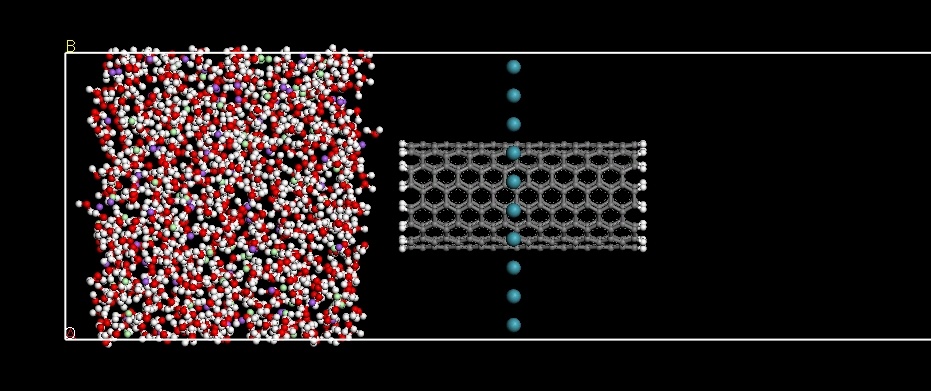
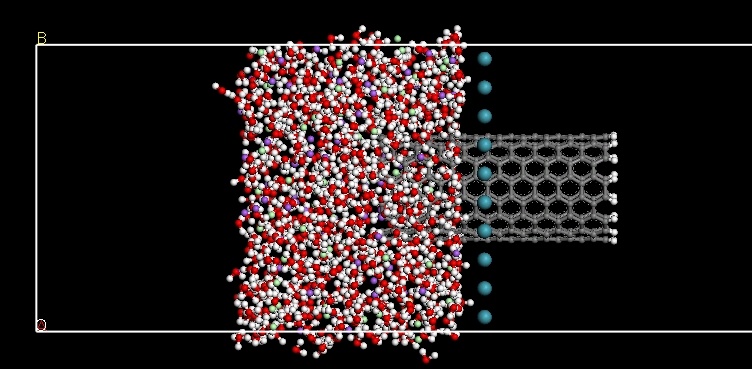
I'm trying to construct an impermeable wall to prevent passage of water molecules outside the CNT because I want them to pass only through the tube. I used a layer composed of Xe atoms and deleted the atoms which fall inside the CNT. However, when I applied NVT-MD, I realized that Xe atoms outside the CNT also affect the inside and molecules still act like there is a wall and they don't pass through the tube as you can see in the figures. When I remove the wall, they do pass. What could be the reason for this? Is it about Xenon? What can I use instead?
I would be really grateful if you could help me.
Thanks,
Aysa

If it was a scripted run please also post the script.
I am posting the files as attachment.
Could you please also post the force field file?
I have at least some ideas whet might go wrong:
Hi Carsten,
Thank you so much for your ideas. You are right, the images and and .xsd file are not the same. I tried the .xsd file that I attached first, then I thought hydrogens bound to CNT end can keep water molecules. I slided the Xe wall to the middle. I saw that water molecules can actually enter the tube, but they can proceed only until they get close to Xe wall.
I didn't suprise that COMPASSII has worked, thank you for trying. I tried Universal and it worked, too. But I need to use TIP3P parameters to model water molecules, that's why I use an edited forcefield.
I also tried applying much higher force, up to 500 kcal/mol/A. Water molecules gets closer to wall but they don't pass.
Also some more suggestions:
Thank you so much for your suggestions.
I tried to put a single water molecule, to remove the wall and to remove the wall and CNT together. In those cases, water molecules pass very quickly suggesting that the force I appy is more than enough. I also tried another element, I placed a graphene sheet instead of Xe wall, this wall also prevented the motion. I am posting my forcefield file as attachment.
Keep in mind that the total external force is divided equally among all atoms in the set. I have found that it takes a force of about 10 kcal/mol/A to overcome cohesion and pull a water molecule out of the liquid phase.
In the attached example, I tried to make the simulation a lot faster, so I could easily play with the parameters. So I deleted the salt so I can switch to group based charges and I deleted all but 200 waters. For the external force, I used 2000. I also wrote the trajectory frequently every 50 steps so I could see what is going on.
The simulations usually end prematurely as molecule slam against the wall.
Best,
Jason