
Dear all,
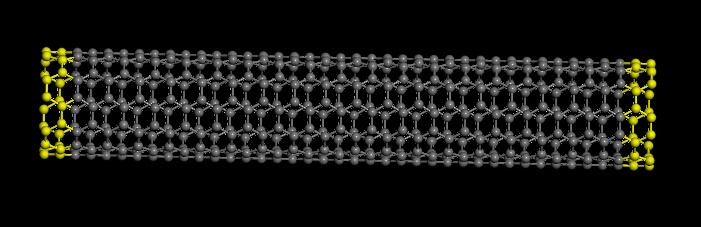
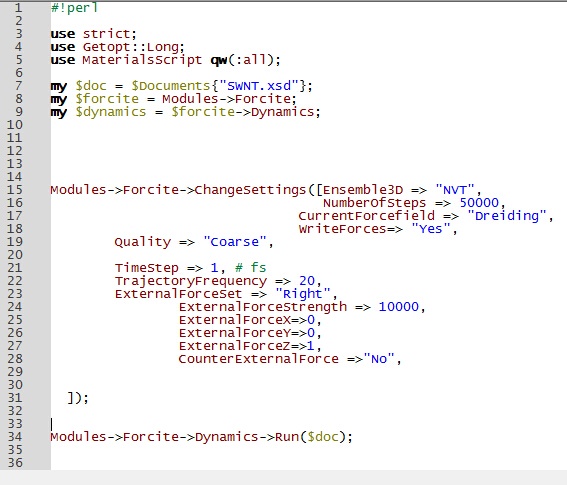
I want to investigate what happens when the structure of my MD simulation system has been broken. In my simulation system, I have fixed the positions of atoms at left side and added an extremely large force on the atoms at right side of my system, my simulation system and perl script were shown in these two figures below:
During the simulation time, my system has deformed a lot, the figure below shows one frame of simulation:

However, the chemical bonds of my systems were not broken yet although I have already add an extremely large force on my simulation system. How to break the structure of my system? Are the chemical bonds in my system unbreakable? Thank.
Best regards,
Yours
CHENG Xu
I want to investigate what happens when the structure of my MD simulation system has been broken. In my simulation system, I have fixed the positions of atoms at left side and added an extremely large force on the atoms at right side of my system, my simulation system and perl script were shown in these two figures below:
During the simulation time, my system has deformed a lot, the figure below shows one frame of simulation:
However, the chemical bonds of my systems were not broken yet although I have already add an extremely large force on my simulation system. How to break the structure of my system? Are the chemical bonds in my system unbreakable? Thank.
Best regards,
Yours
CHENG Xu

Dreiding doesn't support bond breaking; all bonds are harmonic no matter how large the applied force.
In fact, none of the force fields in Forcite support this. You will need to use quantum mechanics, or a reactive forcefield (available in GULP).
Alternatively, you could script a bond breaking algorithm. E.g. if a bond length exceeds a threshold you could delete it, and start a new dynamics run.
Bye,
Reinier
How to script bond breaking algorithm?
Thanks.
Yours
CHENG Xu