
MerConcept, innovative by nature
MerConcept pushes the limits of ocean racing by harnessing the aerodynamic power of the SVR-LAZARTIGUE trimaran using 3DEXPERIENCE on the cloud and contributes to rethinking sustainable mobility on oceans.
SVR-LAZARTIGUE, a boat built to fly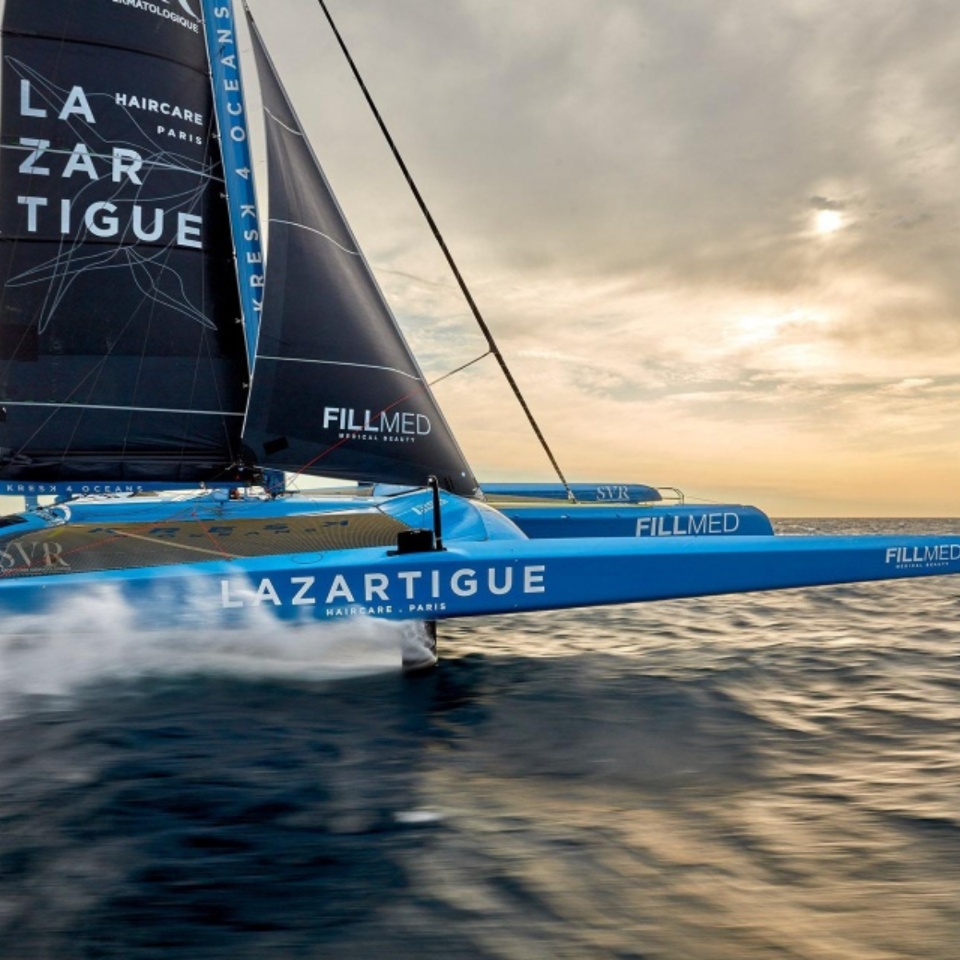
Take a handful of the world’s most innovative sailing machines and race them in brutal winter conditions across the North Atlantic Sea and you have the Transat Jacques Vabre, one of the most elite and challenging yachting races on the planet. The largest class of boats to compete in the grueling 7,500 mile-ocean sprint are the 32-meter long Ultim trimarans, giants of the seas that reach incredible speeds to literally fly over the surface of the water.
In its debut race, newcomer SVR-LAZARTIGUE crossed the finish line in 16 days 9 hours 46 minutes and 11 seconds to take second place. When French sailing duo François Gabart and Tom Laperche set out on the double-handed transatlantic race from Le Havre to Martinique, their main goal was simply to reach the other side safely; a podium place surpassed all expectations.
Two and a half years in the making, SVR-LAZARTIGUE was developed and built by Gabart’s own company, MerConcept, the offshore racing specialist that was also responsible for the M100 Ultim trimaran – winner of the Transat Jacques Vabre, the English Transat, The Bridge, and holder of the round-the-world solo record in 2017 (manned by Gabart).
"MerConcept is about passion. It’s a passion for the sea, the wind, and the waves – harnessing their power to go ever faster. It’s a passion for boats, which have made ocean racing my professional career. After 30 years of sailing, I still marvel at being able to roam the oceans at full speed."
François Gabart, founder of MerConcept and SVR-LAZARTIGUE skipper.
Innovative and competitive by nature, MerConcept’s success is built on its ability to combine deep industry knowledge and the latest technological capabilities to create unique and revolutionary designs. The company’s partnership with Dassault Systèmes plays a critical role in this, delivering the solution it needs to develop the boats from start to finish, and better understand and anticipate their behavior at sea.
To successfully carry out a project like SVR-LAZARTIGUE, in addition to passion, you need to have knowledge and experience of the boat.
Our close collaboration with Dassault Systèmes began in 2011, when we built François Gabart’s first IMOCA-class yacht. We used CATIA to design the boat and all composites parts. We have since moved to the 3DEXPERIENCE platform on cloud and our level of expertise with the solution has significantly evolved.”
Antoine Gautier, Design Office Manager, MerConcept.
Collaborating on a virtual twin
SVR-LAZARTIGUE is the result of a mammoth engineering endeavor bringing together expertise from all around the world.
"To design and build a boat like SVR-LAZARTIGUE, it takes around 150,000 hours of work, involving more than 150 external collaborations. There’s a lot of collaborative work involved, synchronizing tasks, moving from the design phase to the construction phase."
Thomas Normand, CEO of MerConcept.
Before moving to the 3DEXPERIENCE platform, it was challenging keeping everyone up to date with progress and ensuring they were all working with the latest version. Now, MerConcept has a common data environment, where everyone can work together on the same 3D model – critical for orchestrating all participants and successfully bringing the boat from concept to reality.
"If we focus on the design phase, we need to work with tools that are as collaborative, intuitive and easy to use as possible. Using ENOVIA, the construction and design phase is as smooth as it can be, and that we can support effective information sharing among all the different parties.”
Thomas Normand.
With multiple people working on the design at any one time, ENOVIA helps to ensure that technical modifications are correctly implemented, and all affected stakeholders are notified.
"For me, the advantages of the 3DEXPERIENCE platform on the cloud are that we can all interact on the same model. Everyone needs to be up to date, so that everyone can see what has been done, and avoid interference issues."
Antoine Gautier.
MerConcept’s 3D model of SVR-LAZARTIGUE is a true virtual twin of the physical boat, available in the cloud. This virtual twin is a physically accurate 3D model of the trimaran and its systems viewed in the context of its environment at sea through simulation. It allows the team to virtually design SVR-LAZARTIGUE, complete with all system behaviors, and test it in limitless scenarios.
"The virtual twin also allows all relevant stakeholders to access the current model in real-time and focus on the part or the system that interests them. Different teams can ‘speak the same language and know that what they’re working on is directly linked to what is actually going on in the workshop."
Antoine Gautier.
Refining the design at sea
MerConcept uses the virtual twin of SVR-LAZARTIGUE to not only refine its designs but manage the boat throughout its lifecycle and make constant improvements based on data collected from tests and races.
"The virtual twin must be able to evolve over time because, once the boat is in the water, it has a lifecycle of between four and six years corresponding to the next races."
Antoine Gautier.
MerConcept’s performance department acts as the interface between the boat’s navigation and the design office, which constantly updates the virtual twin.
"Every time we sail, train or race, a lot of data is sent back to MerConcept. This is processed and analyzed, and sometimes results in modifications to parts, systems, or even the structure of the boat."
Antoine Gautier.
The fact the 3DEXPERIENCE platform is cloud-based has been crucial for collecting and retrieving data when the boat is at sea.
"Thanks to the cloud, we are able to connect from anywhere with an internet connection. When we’re on the water, we can access the 3DEXPERIENCE platform and see the boat’s plans and 3D model – critical if we experience any damage or otherwise. We can read the plans and try to understand in more detail what has happened. Thanks to this system, we can bridge the gap between virtual and reality.”
Antoine Gautier.
Sustainable ambitions
Beyond racing, MerConcept is building on its ambition to harness its expertise in racing for the greater benefit of the global maritime industry. The company became an “entreprise à mission” (a French legal framework in which companies adopt specific sustainability goals) at the end of 2019 and set up a new research and development lab focused on broader marine applications.
"We all need to make a huge effort to reduce our daily carbon impact. That includes our daily transport. Our business is the sea, so we can be responsible for reducing our carbon impact on the oceans when we build boats and participate in races. But also, if we manage to collaborate with the shipping industry on projects that reduce their carbon impact and benefit our planet in the years to come, we’ll be very happy."
Thomas Normand, CEO of MerConcept.
Thomas shared an example of a ferry project MerConcept is working on:
"Foils allow boats to lift themselves above the water and gain power and speed. We are working on equipping a ferry, which will carry between 100 and 200 people, with these foils. It will be able to fly above the water and cut its energy consumption by half. This type of project is likely to emerge in the coming years."
Backed by the power of the 3DEXPERIENCE platform, MerConcept is not only pushing the boundaries of what’s possible in ocean racing but helping to reinvent the very concept of marine transport to preserve the planet and protect the oceans.
"We have this extraordinary ability to cover thousands of kilometers using only wind force to make our boats fly at full speed. There is still so much to explore. Now more than ever, we must give meaning to progress so that the future remains full of dreams and promises."
